Deborah Roberts is a mixed media artist who works across painting, collage, text and installation. Roberts’ figurative works challenge ideas of beauty and depict the complexity of Black subjecthood. Her artworks explore themes of childhood, race, identity politics and gender through symbolism and double meanings.
Get art resources sent straight to your email:

Deborah Roberts was born in Austin, Texas, USA in 1962 where she now lives and works as an artist. She studied at the University of North Texas, Denton, Texas in 1985, and then Syracuse University as a Research Fellow in New York in 2014.
Roberts is well known for her portraiture collages and paintings that explore topics of Black girlhood and childhood. Her artworks aim to challenge traditional, Western ideas of Black beauty and identity, as well as deal with issues that Black children face.
Deborah Roberts works in mixed media and collage, meaning her artworks are made using a range of different materials such as papers, graphite, ink and acrylic paint. Roberts creates large-scale artworks showing striking, fragmented portraits – often combining vibrant pattern and colour against simple backgrounds.

Consider the Formal Elements of art… Which do you think are most prominent in the diptych ‘Tomorrow, tomorrow and tomorrow’, (2023) above?
The artist has made clever use of pattern, contrast and colour to instantly draw our eye to the faces in the middle of the piece. There is also symmetry in the layout of the work that creates a sense of balance. Why do you think Roberts has decided to make use of both a black then white background? Can you see any other compositional elements in the work?
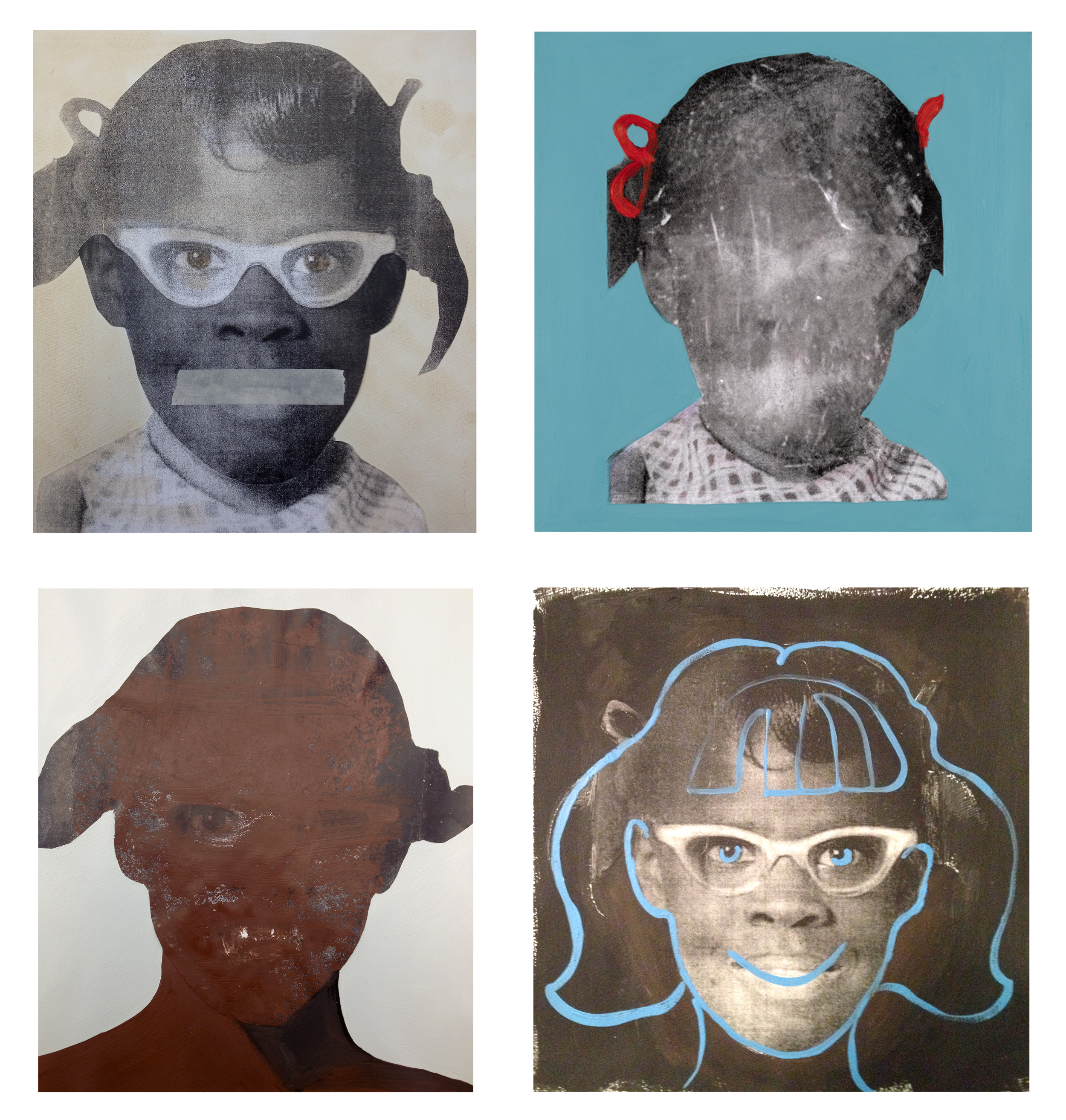
Look at the piece ‘Little Debbie’ above. This is a series of self-portraits, using photographs of the artist from when she was younger. How do you think the series of four collaged portraits explores ideas of identity?
Roberts uses collage to show different layers, colours and textures. Each face looks like it has carefully been dismantled and rearranged. Using collage allows the artist to reflect the challenges of young, Black children trying to build their own identities.
The artist collages together several faces or features to make up one image, disrupting traditional ideas of the black image in Western art. Roberts then directly invites the viewer to look for humanity within the works by having the eyes of the figure(s) looking straight out.
Top facts about artist Deborah Roberts
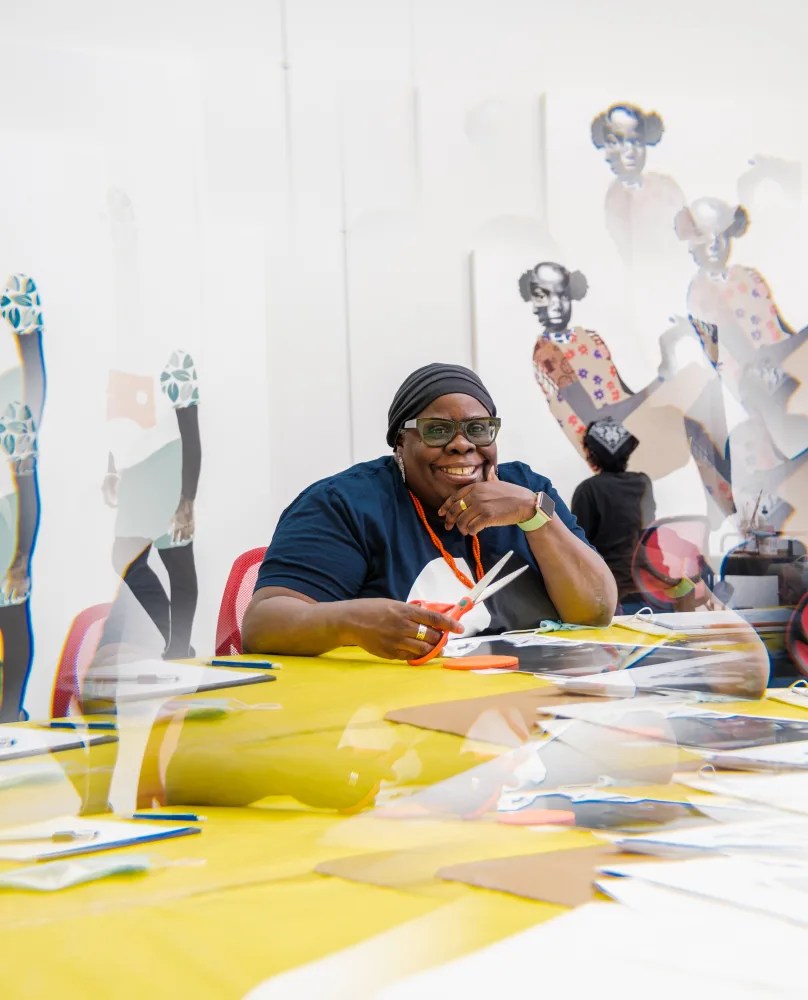
- Deborah Roberts was born in America in 1962
- She lives and works in Austin, Texas
- Roberts received her MFA from Syracuse University, New York
- She is one of eight children
- Her artwork has been exhibited internationally across the USA and Europe
- Roberts’ work is in the collections of the Whitney Museum of American Art, New York
- Roberts has always loved drawing and drew for other students in her school to earn some money
- When she didn’t have any paper, Roberts drew on the back of the couch at home (and got into a lot of trouble!)
- She is influenced by Dadaism and artists such as Kurt Schwitters
- Roberts has over 60,000 followers on her Instagram account
To create her artworks, Deborah Roberts uses collages and groups different parts of faces together. By cutting up and overlapping different features, she challenges the notion that there is not one monolithic idea of blackness; each piece has multiple faces, multiple people and multiple experiences in one. When the collaged elements of the work are complete, Roberts adds drawing and painting over the top.
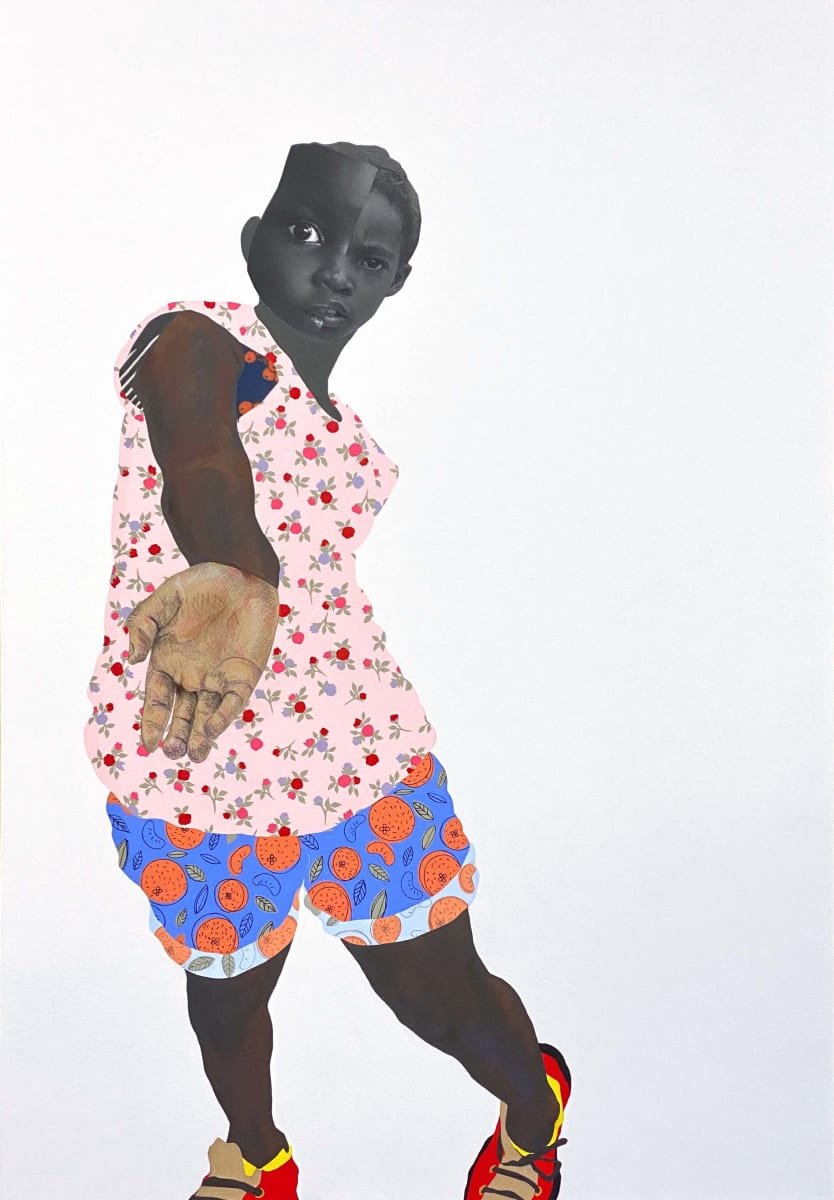
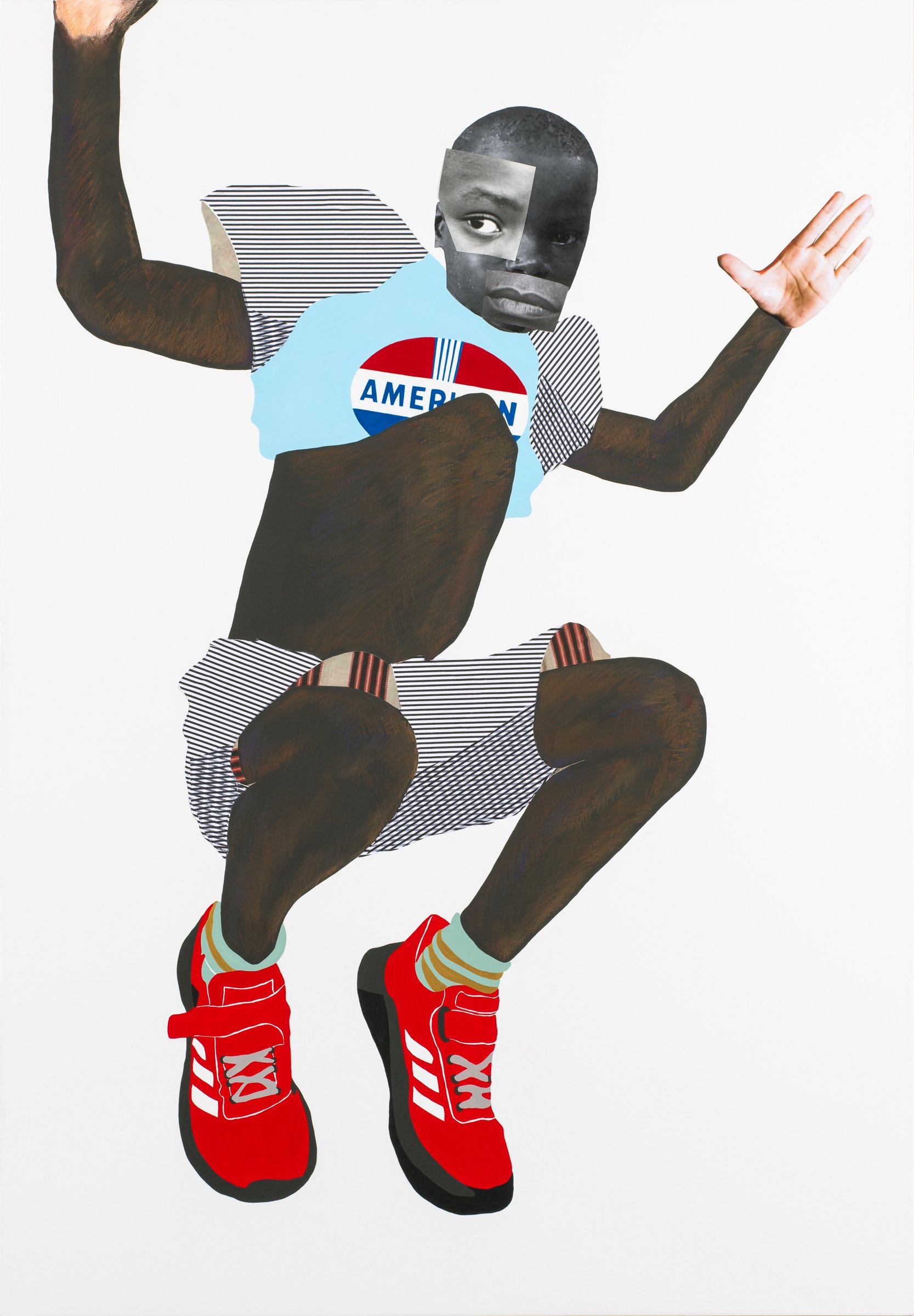
Look at the pieces above. How do you think Roberts has created a sense of innocence and personality in the work, even though there are multiple faces used to create each piece?
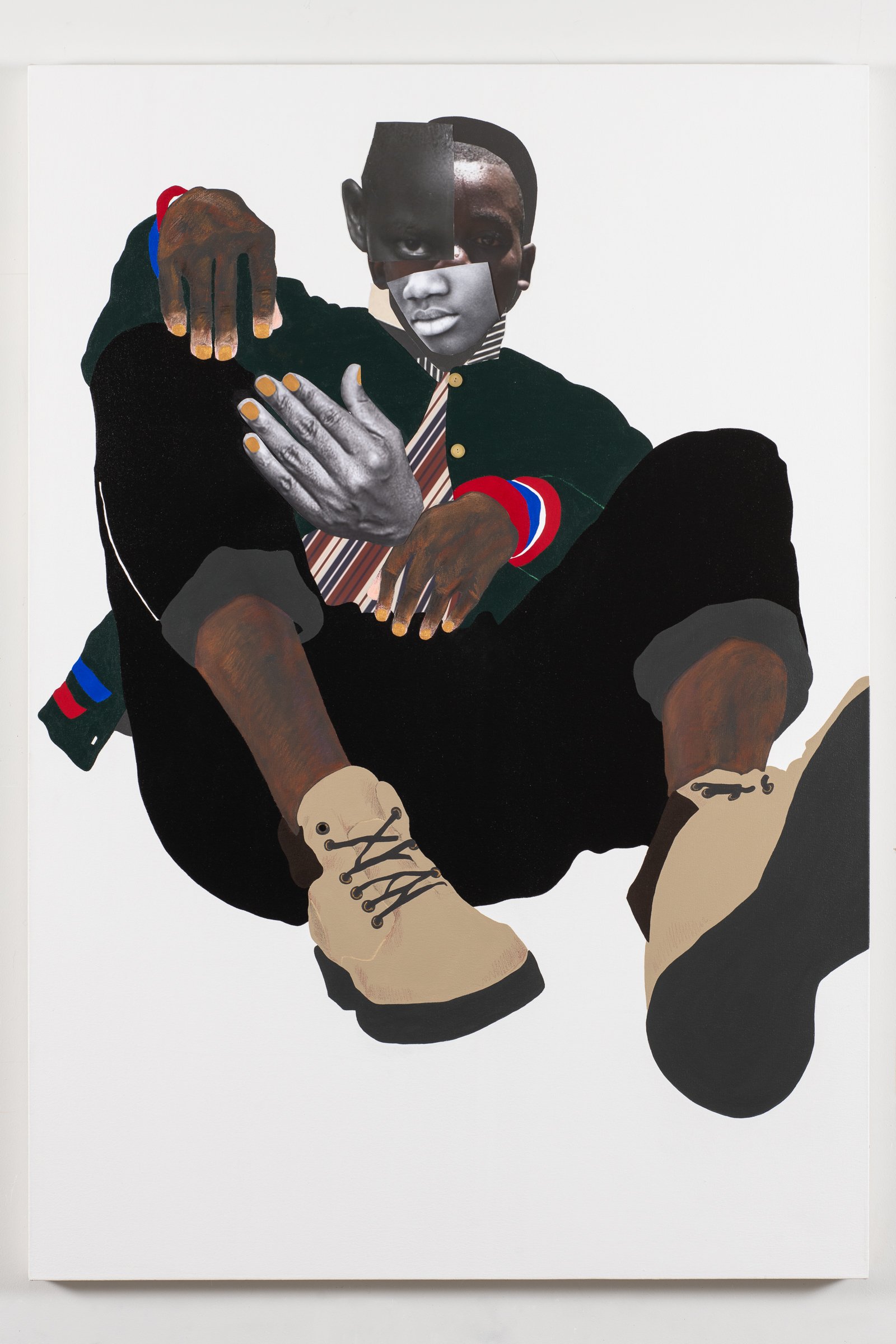
Look at the piece, Jamal (2020), above. Can you think of 5 adjectives to describe the artwork? Which parts do you think have been made with collage, and which have been painted?
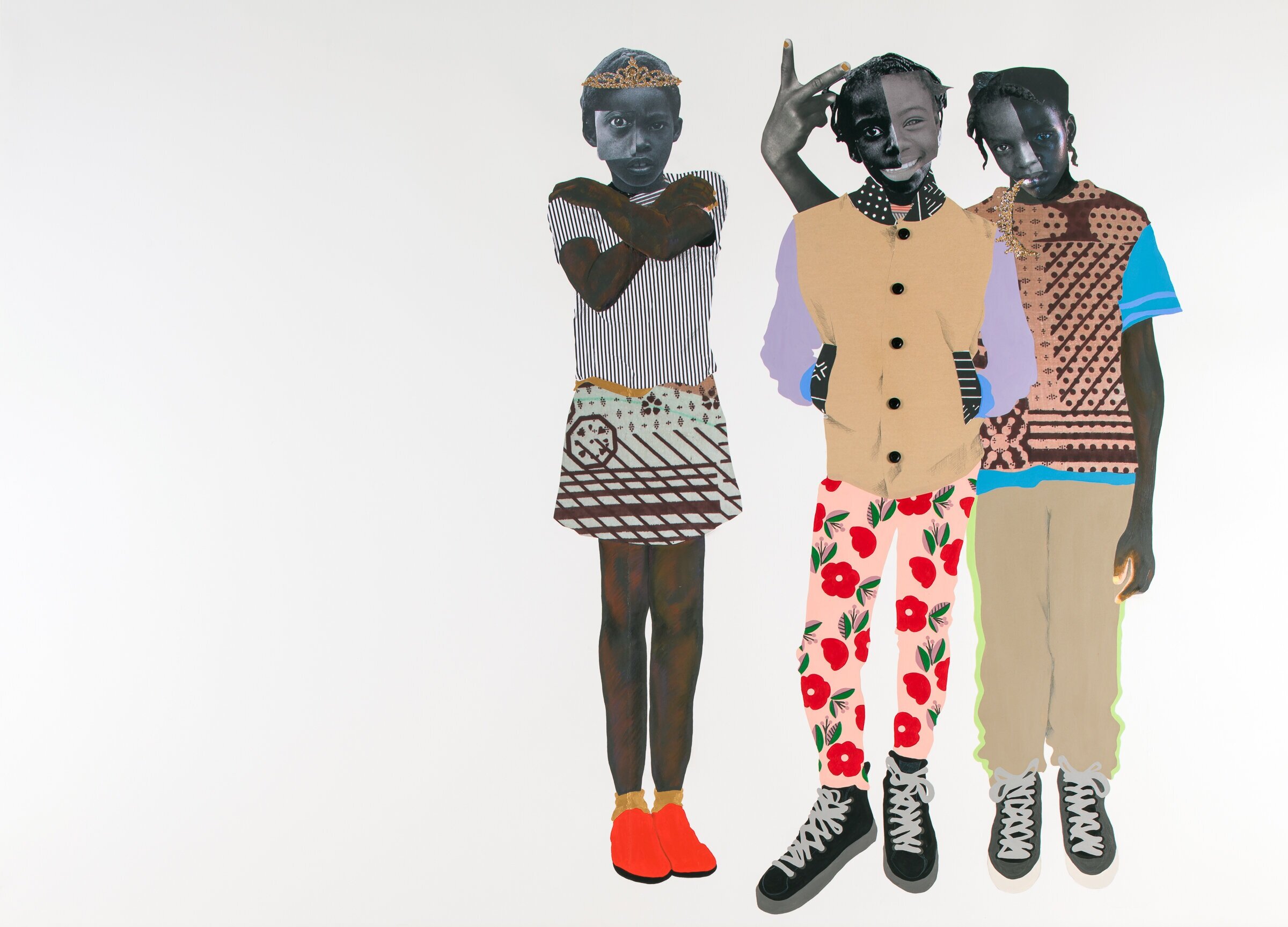
In Between Them, (2019) we can see three young, black children standing closely to each other looking directly out towards the viewer. Their faces are made up of different facial features all collaged together. We can assume the children are friends as they are standing closely together and in relaxed positions – one has their arm behind another. The children are wearing brightly patterned clothes that have a beige, brown and neutral colour palette, apart from bright red and blue pops of colour which act as accents. The artist has used colour and specific pattern styles to create a balance from left to right and top to bottom in her composition.
How do you think the artist has drawn attention to the facial features of the children? Think about her use of negative space, colour and pattern.
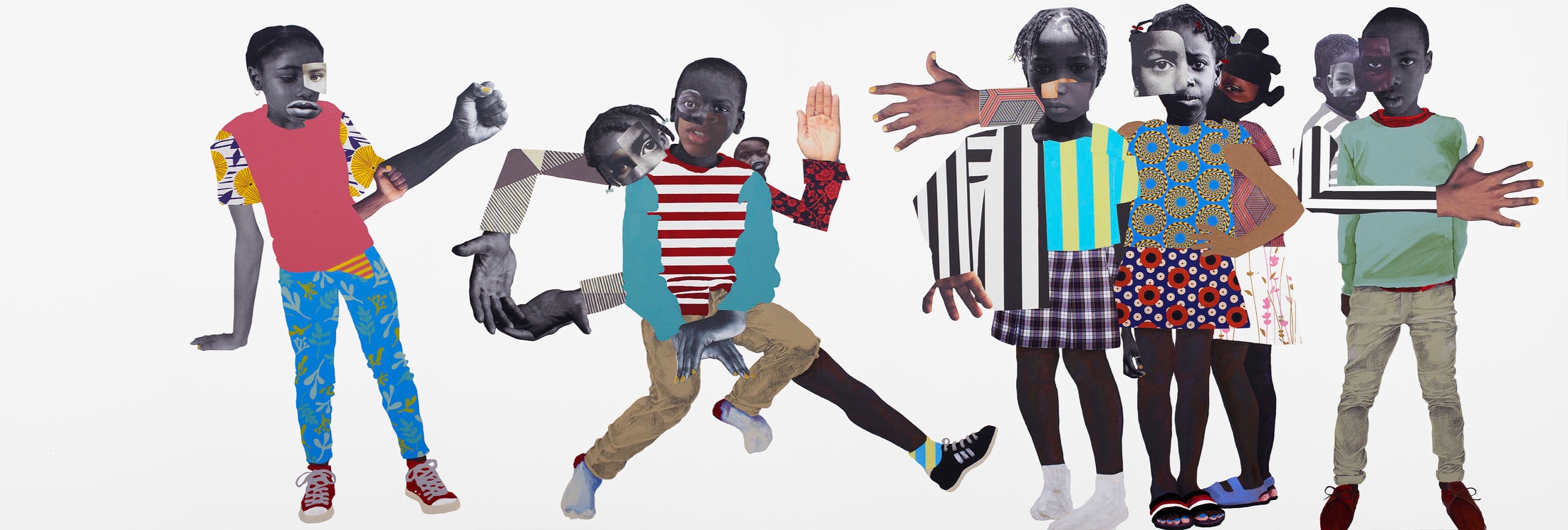
Deborah Roberts creates artworks that explore themes related to childhood and visual culture. Her work aims to highlight a broader view of beauty by using collage, pattern and colour in an inventive and original way, showing her figures in playful yet powerful positions. Speaking about her work, Roberts says:
I was working within notions of blackness and black beauty and identity politics, the way they have historically been structured. Where if you do not have blonde hair and blue eyes, then you aren’t considered beautiful.

Have a look at Deborah Roberts’ Instagram page to see more of her work and interviews with the artist:
How to create artwork like Deborah Roberts:
I would recommend collecting a large range of images that you would like to work with first; newspapers, magazines and leaflets etc. would be a good place to start! Roberts uses acrylic in her work and the brands below are good quality. You could also outline features and parts of the collages like Roberts does, using Posca Pens for more control:


For more insight into Roberts’ work and to hear from the artist herself, the interview below is great:
Get art resources sent straight to your email
What do you think about Deborah Roberts artworks? What themes or ideas can you see the artist exploring in her work? Let me know in the comments!

