Mechelle Bounpraseuth is a ceramic artist inspired by food. She creates wonderful, life-sized 3D clay sculptures of food, condiment bottles, discarded items, litter and other types of everyday objects.
Get art resources sent straight to your email:


Mechelle Bounpraseuth is an artist working in 3D who lives in Sydney, Australia. She creates clay artworks inspired by her family (from Laos) and the food they ate when she was younger. She says ‘every bottle, every jar reminds me of them’. Mechelle Bounpraseuth is interested in exploring her culture and past by celebrating the food she ate with her family growing up.
Mechelle Bounpraseuth chooses to sculpt her bottles and objects from clay. She draws them first then starts to build them. Finally she paints them to carefully show the labels and details. Why do you think she uses clay? What other materials could she use to make her artwork?

Food artist Mechelle Bounpraseuth doesn’t make her 3D objects ‘perfect’ when she creates them from clay. Sometimes they look quite wonky, child-like or like they are leaning. It may be important for the artist that her food sculptures look hand-made. When she talks about her artwork, she describes her memories of growing up and the food she used to eat as a child:
As a kid we always knew when we were having Pho for lunch because the process started early in the morning. I’d wake up to a huge pot bubbling away on the stove top. As the morning passed the smell of pho broth wafted through the house making your mouth water and your belly rumble.
– Mechelle Bounpraseuth
How do you think the style of Mechelle Bounpraseuth’s 3D food sculptures show that she was inspired by her memories of food growing up? Think about how the artist has made her work seem childlike.
If you’d like some help writing your annotations in Art or Photography, look no further.
Open the assistant in a separate window and move it next to your artwork or photograph. Your answers stay with you. Build your own analysis step by step. Use the prompts to make links between what you see, how the artist worked, the mood created and your own ideas. Analyse an artwork using the questions below. Look closely at the artwork and describe what is visible before thinking about its meaning. Describe visible details such as people, objects, setting, colours, shapes and actions. Focus on what you can actually see; save ideas about meaning for later. Sentence starter: Can you be more precise? What details tell you this? Think about the focal point, scale, unusual details and where your eye travels. Sentence starter: Where does your eye move next? How has the artist guided it? Explore the visual language: line, shape, colour, tone, texture, pattern, space, form and composition. Choose the elements you can support with visible evidence. Sentence starter: Can you name a specific area of the artwork as evidence? Look at the overall palette. Consider whether it is warm, cool, limited, complementary, analogous, contrasting, muted or vibrant, and notice where colours appear. Sentence starter: How would you describe the overall palette? Which colours work together or contrast? Is the scheme warm, cool, limited, muted or vibrant, and how does it affect the artwork? Connect two or more choices, such as colour and mood, line and movement, or tone and depth. Sentence starter: Does the colour strengthen the mood, or does another element change the effect? Think about materials, methods and visible evidence of how the artwork may have been made. Use visible clues such as marks, layering, edges, surface and finish. Sentence starter: What visual evidence supports your idea? Could the mark have been made another way? Choose a process you could test in your own sketchbook, rather than simply copy the finished image. Sentence starter: What would you change about the technique to make it your own? Explain the feeling or atmosphere and link it to visible choices. Avoid treating one colour as having only one meaning. Choose precise words, such as tense, calm, energetic, uneasy, playful or lonely. Sentence starter: Could another viewer feel differently? Which details support your interpretation? Look at the whole palette and connect it with tone, composition, subject and marks. Sentence starter: Which parts of the colour scheme help create this mood? Are other features—such as tone, line, texture, shape or composition—also contributing? Could the same palette create a different mood in another artwork? Make clear links between what you noticed and what you plan to do next. Think about an approach, not copying the artist’s exact image. Sentence starter: How could you combine this with an idea, material or subject from your own project? Make your next step specific and practical. Sentence starter: How will you judge whether the experiment worked? What could you change if it does not? Look closely at the photograph. Describe what is visible before interpreting its meaning. Describe the subject, setting, objects, people, gestures and details actually visible in the photograph. Sentence starter: What small detail might another viewer overlook? Identify the focal point and consider framing, viewpoint, foreground and background. Sentence starter: How might a different crop or viewpoint change what you notice? Examine framing, camera angle, focus, depth of field, exposure, contrast, light and colour or monochrome. Consider the crop, rule of thirds, leading lines, symmetry, viewpoint, negative space and the relationship between foreground and background. Sentence starter: What would change if the camera were moved higher, lower or closer? Look at the direction and quality of light, highlights, shadows, contrast and the palette. Black-and-white photographs can be analysed through tonal range. Sentence starter: Could the lighting be natural, artificial or mixed? What evidence supports your answer? Consider focus, depth of field, motion blur, shutter speed and how these direct attention. Do not assume the camera settings are known. Sentence starter: How would a wider depth of field or a faster shutter speed change the image? Investigate how the image might have been captured and produced. Consider digital editing, analogue darkroom techniques and physical alterations made by hand to photographic prints. Use evidence to discuss lens choice, camera position, exposure, shutter speed, aperture, film grain, digital noise or editing. Only claim a method when it is known. Sentence starter: Could this effect have been created in-camera, through digital editing, in the darkroom or by physically altering a print? What evidence can you see? Consider digital adjustments and retouching; analogue darkroom methods such as dodging, burning and photograms; and physical editing by hand, such as cutting, tearing, folding, stitching, scratching, collage, drawing, painting or layering onto a printed photograph. Only describe methods as facts when you have evidence. Sentence starter: Compare digital editing, darkroom manipulation and editing a print by hand. How might stitching, collage, scratching or painting onto the photograph change its meaning or mood? Interpret the photograph, supporting your ideas with visible evidence rather than assumptions. Use precise language and connect it to light, tone, framing, focus and subject matter. Sentence starter: Could a different viewer interpret the same image differently? Why? Consider context, storytelling, documentary or staged approaches, and what is included or excluded by the frame. Distinguish observation from interpretation. Sentence starter: What might be happening outside the frame? How does that affect your interpretation? Turn your analysis into a practical experiment for your own photography. Choose a compositional or technical approach to explore, rather than copying the photograph. Sentence starter: How could you achieve a similar effect with either a digital camera or analogue film? Plan your subject, location, framing and light, then decide whether to edit digitally, experiment in the darkroom or alter a physical print by hand. Explain how you will compare results. Sentence starter: How could you develop one photograph further through digital editing, darkroom techniques or cutting, stitching, collage or drawing on a print? Read, edit and connect your ideas. This is a draft, so make sure it reflects what you actually observed and thought. Spelling support applies common corrections across answer boxes and the final draft, alongside your browser’s English spell checker. Always check suggested changes. Feedback helps you develop your own ideas; it does not grade your work.GCSE Art Annotation Assistant
Content
Challenge question
Challenge question
Form
Challenge question
Challenge question
Challenge question
Process
Challenge question
Challenge question
Mood
Challenge question
Challenge question
Your Response
Challenge question
Challenge question
Content
Challenge question
Challenge question
Composition and Light
Challenge question
Challenge question
Challenge question
Photographic Process
Challenge question
Challenge question
Mood and Meaning
Challenge question
Challenge question
Your Photographic Response
Challenge question
Challenge question
Your annotation

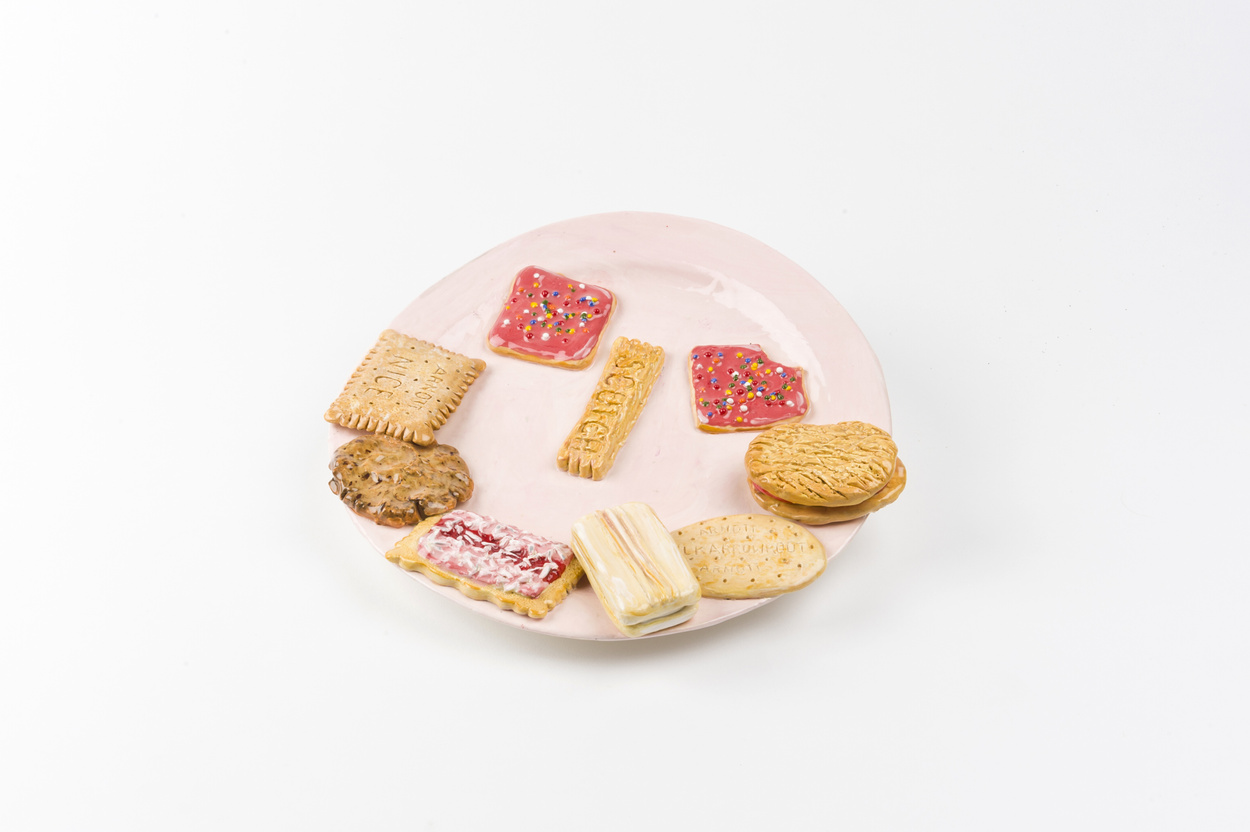
Mechelle Bounpraseuth creates her 3D food art with a playful, fun style. She presents her ‘food’ on plates as she would have eaten them as a child. Look at the way she has presented the ceramic biscuits on the plate below! She has also used bright colours (such as a pink plate) and a clear glaze. The clear glaze makes the work look glossy – making us want to pick it up and eat it. A good word to describe the food art by Mechelle Bounpraseuth is ‘tactile’.
Although we know the ceramic food objects are not real, the artist has included some details to add elements of realism to her work. Look at the textures in the biscuits which have been incised into the clay and the sprinkles that have been added on, or all of the words that have been included on the ceramic condiment bottles. It is almost as if the artist is sculpting her memories of the food instead of a real object in front of her.
Teaching Mechelle Bounpraseuth? This free interactive artist research quiz helps art students explore Mechelle Bounpraseuth’s sculpture through knowledge questions, close looking, artwork comparisons and a creative drawing activity. Suitable for art lessons or independent study.
Mechelle Bounpraseuth
Art Detective Quiz
Explore the artwork, follow the clues and make something of your own.

Have you REALLY finished this whole quiz in less than 15 minutes?!
Think about your written responses and your artwork before deciding.
There's still time to improve your work!
Use this time to check your answers and add more detail to your drawing. The 15 minutes is a minimum, not a deadline. Take longer if you need to.


DOWNLOAD this page below, for free, as an Artist Research handout to use in your lesson. It includes all of the facts and images, and has questions for students to answer.
What do you think of Mechelle Bounpraseuth’s artwork? How could you describe it? Does it make you hungry? Let me know in the comments!

I’m excited to share these examples with my elementary students who are soon to begin work for our annual full school art show, this year the theme is “Food Frenzy!”
Sounds amazing! I would love to see what they come up with 😀