How to Analyse Art: A Guide for Art Students, Teenagers and… Anyone else asking ‘what does it mean?’ 🖼️ 💡
If you’re looking for help with your art annotations, or help writing about art in general, click here to use the GCSE Art Annotation Assistant.

Ever looked at a piece of art and thought… What on earth is going on here? Or wondered how to ‘read’ an artwork to find a deeper meaning?

At first, analysing art can feel strange or even a bit intimidating – but that’s exactly what makes it exciting.
When you learn how to look closely at an artwork, hidden stories, symbols, and ideas begin to appear.
Reading or finding meaning in artworks can improve your appreciation of different styles and techniques, which will (hopefully) help you be more confident in giving your opinion or thoughts about pieces.

The good news? There is no ‘wrong’ way to look at or understand art, but a few guidelines can always help! Especially if you can’t say why the artwork makes you feel a certain way.
This step-by-step guide will walk you through the process of analysing art, helping you to see and understand art with fresh eyes and confidence. I have broken the guide down into 6 sections:
- The Basics – subject matter and medium
- Composition – layout, elements and space
- Colours – colour schemes and light
- Techniques – skills and processes
- Context – background and cultural contexts
- Mood – themes and emotions

Each of the 6 sections are outlined in more detail below.
TL;DR? If you’d like a more snappy version to use in lessons, click here for a printable helpsheet.
🎨 WANT MORE ART TEACHING RESOURCES?
Join the Art Teacher Club for just £3 per month – less than a coffee!

Get new high quality art resources every month – including projects, worksheets, PowerPoints and printable teaching materials. For £3/month you will get access to the Membership Area and each month, new resources and projects will be available there.
Resources already trusted by thousands of art teachers – join them now 💡

What does ‘analyse‘ mean? In art, analysing means studying something in detail, taking account of all the different elements and features in order to understand it better.
An understanding of the Formal / Visual Elements of Art will help.
Step 1: Start with the Basics
This sounds obvious but it’s important. Start by looking at the artwork closely. Spend at least two full minutes looking at the artwork (if you can see it in real life, even better!) Take your time to notice the following:
- Subject Matter: What is the subject of the artwork? What is it about? Identify the main objects, people, or scenes depicted.
- Medium: What materials did the artist use? This could be oil paint, watercolor, acrylic, pastels, 3D materials or even digital forms.
Let’s analyse the Subject Matter and Medium in this painting by Vincent Valdez:
In this painting, People of the Sun (Grandparents Santana), by Vincent Valdez, the subject matter is clearly the two elderly figures stood side by side. There are other objects in the painting, like the fabric background, the radio and the cactus, however they are much smaller and not the main focal point of the composition. The tone of the painting is light with strong shadows, and one figure is wearing sunglasses – could they be stood outside? Perhaps in their garden with some of their washing behind them? Why can’t we see the rest of the scene? Is it a painting of a memory?
The artist has used oil paints which allow him to achieve different textures in the work – the figures are painted with realism, and look sharp. This is in contrast to the background fabric which seems softer and almost fades into white.
Step 2: Explore Composition
Composition is just a fancy word for ‘layout’ and refers to how the different elements are arranged within the artwork. The way elements are laid out impacts how we ‘read’ an artwork. Consider:
- Layout: What is the overall arrangement? Is it balanced or asymmetrical? Is there a focal point?
- Elements (Lines and Shapes): Are there strong lines guiding your eye? What shapes are predominant? Are they geometric or organic?
- Space: How does the artist use space? Is it crowded with detail, or is there a sense of emptiness?
Let’s analyse the Layout, Elements, and Space in this painting by Boris Nzebo:
The layout of this painting called ‘Transmission‘ by Boris Nzebo is complex and multilayered. We could describe it as being quite chaotic and busy. Every bit of space has been taken up with lines or shapes. So how can we start to understand what is going on? Look closely, and you can see that the layout is busiest in the middle of the painting. In the background we can see a figure touching another figure’s hair. There are two figures sat casually in the middle distance. At the very back there are bottles and shelves, could this be a hairdressers?
The shapes are simplified, so even though the layout is complex, we can still see the subjects: In the foreground, we can see a fourth figure from behind, but only their head, which has transparent sections. Each part of the painting is made up of lines, line is a formal element which is clearly important in this painting – almost like roads or parts of a map overlapping. The use of simple lines in the background suggests a room or building.
Could the artist be interested in trying to capture the busy, jostling atmosphere of people in a city? Maybe the artist is interested in how people interact with their environments? The background literally ‘cuts through’ part of the figure to create this complex composition. The figures and the buildings overlap, where does one start and the other end?
Step 3: Examine Colour and Light
Artists choose their colour schemes carefully. Colours can convey time, emotions and set the mood of the scene. The colours in an artwork are usually what create the mood or feeling of the piece. Think about:
- Colour Schemes: What colors are used? Are they warm, cool, or neutral? How do they affect the feel of the artwork?
- Contrast and Light: Where does the light come from? Are there bright highlights and deep shadows? How do these affect the composition?
Let’s analyse the Colour Schemes and Light in this textile work by Liv Aanrud:
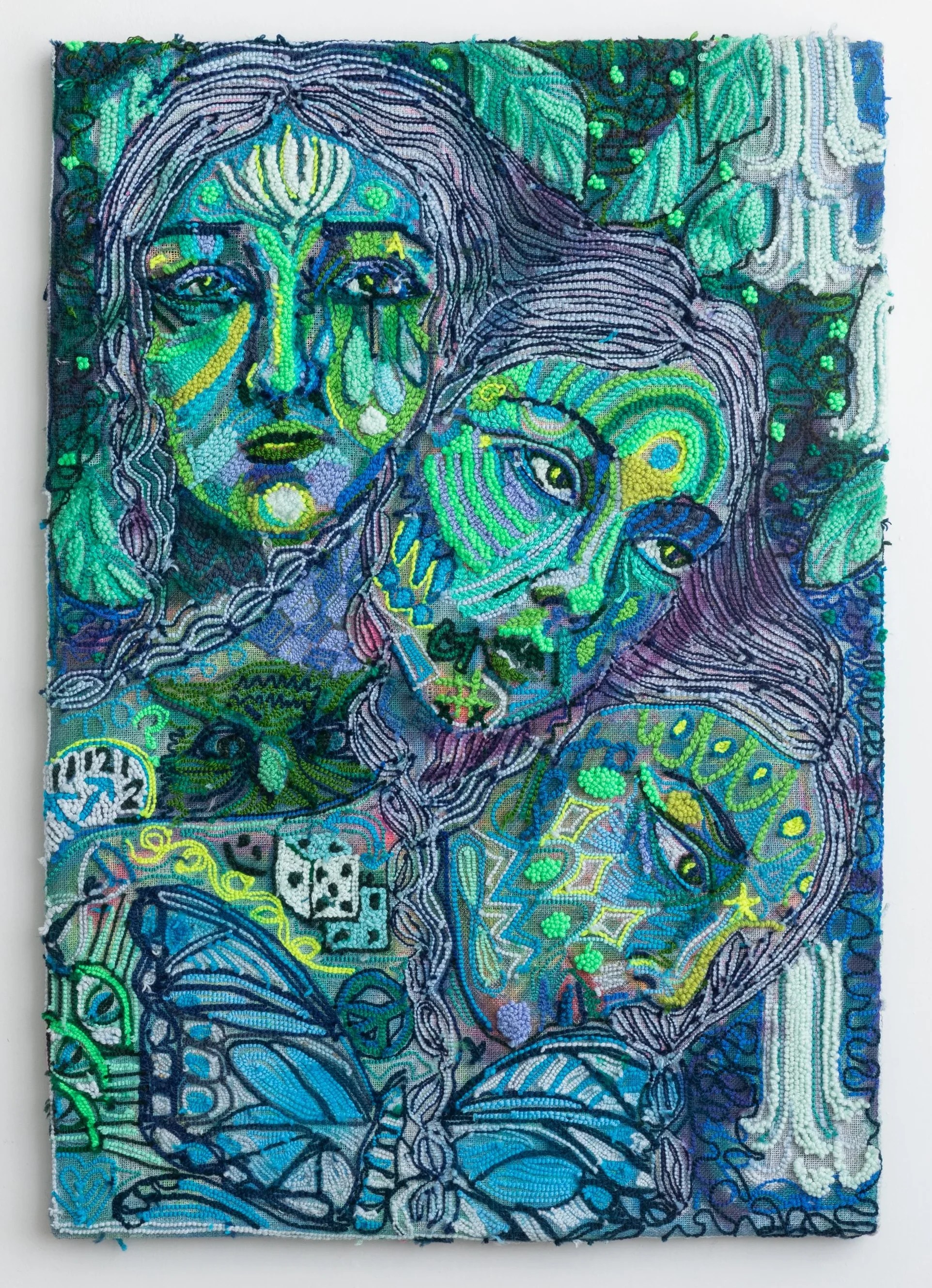
The cool colours used in this piece by Liv Aanrud reflect the somber, contemplative portraits. The artist has used an analogous colour scheme of greens, blues and purples with their tints and shades. The pale colours and soft pastel tones support the calm feeling of the subjects. Small areas of the piece have more vivid colours that stand out – ensuring we can still see all of the individual features of the artwork. What could the figures in the piece be thinking about?
The tints and shades provide contrast in the piece; parts of the background are darker to enhance the faces. Overall the faces look lighter thanks to the minty green colour used by the artist. The colours are built up in layers which help to connect all of the different elements of the piece. Why do you think the artist has chosen a cool colour scheme in this piece?
Looking for some artist inspiration?
Find a huge list of artists listed by themes here. For example, Landscape Artists, or Artists Inspired by Architecture… Have a look:

Step 4: Consider the artist’s Technique and Process
Understanding an artist’s technique, process or how they go about creating their work can provide insights into their intent.
- Technique: How is the artist using materials? Is it a drawing? Painting? Sculpture? Installation? Video / audio? A combination of different techniques? Why?
- Process: What do you think the artist has had to do to create their artwork(s)? How are they arriving at their final outcome(s)?
Let’s analyse the Technique and Process in this artwork by Lita Albuquerque:

This landscape art by Lita Albuquerque is called ‘Southern Cross’ and was made in 2014. It is an installation, not a painting or photograph. The technique the artist used was to take pure, ultramarine (blue) pigment (powder) and create different sized spheres to place on the landscape. Could the blue colour symbolise the blue of the sky, the further cosmos or planets and stars? Why are they positioned in those particular spots?
The artist has made perfect geometric shapes (spheres) which contrast the natural landscape. This juxtaposition of scientifically perfect shapes / human order vs natural chaos could suggest the human desire to categorise, structure and understand the world around them. The installation will change over time due to natural forces such as weather – what could the artist be trying to say about the human relationship with nature?

Quick Tip 💡
You can usually find out more about an artist’s technique or process on their website or social media channels.
Step 5: Contextualize the Work
This involves learning about the artist and the period in which they worked:
- Artist Background: Who is the artist? What might have shaped their perspective?
- Context: What was happening in the world during the time the artwork was created? Consider historical events, social movements, or personal circumstances.
Let’s analyse the Background and Context in this artwork by Gordon Cheung:

This painting by Gordon Cheung is from a series called ‘Tears of Paradise’. Cheung is a British-Chinese artist based in London. His background of Western and Chinese cultures is shown in his artwork where we can see themes of global power shifts, identity, and the rapid pace of modern technology. At first the painting looks like a beautiful landscape made up of four distinct sections stacked on top of each other.
The background of the work features soft, layered mountains (created with newspaper cuttings) made with sprayed acrylic paint. This pays homage to classical Chinese dynastic landscape paintings. Cheung blends traditional motifs with futuristic, sci-fi elements: Cities float like disconnected islands underneath glittering constellations that double as geopolitical trade maps. The artwork directly responds to China’s rapid 21st-century economic growth and massive state-planned infrastructure projects, such as the “One Belt One Road” initiative.
The title Tears of Paradise creates a stark contrast. While massive infrastructure projects create modern “paradises” or mega-cities (like “Jing-Jin-Ji”, designed to hold over 100 million people), they often come at the expense of traditional culture, historic neighborhoods, and individual human lives.
Step 6: Interpret the Mood and Meaning
This is where your personal response and reaction is important. That first feeling or impression you get when you look at an artwork is completely valid, so think carefully about why you had the reaction you did.
- Themes and Messages: What themes does the artwork explore? These could be love, loss, identity, nature, politics, etc.
- Emotional Response: How does the artwork make you feel? Do you feel happy, sad, intrigued, or confused? Reflecting on your emotions is crucial.

Your task – answer the following questions about this painting ‘Roots’ by Frida Kahlo. There are no wrong answers!
- What themes does the artwork explore?
- How does the artwork make you feel? Can you explain why?
I hope you can use this guide to feel more confident in explaining your thoughts and ideas. Remember, there’s no right or wrong answer when reading or analysing art. Everyone brings their feelings and experiences into their interpretation, making art analysis very subjective.
If you’d like some help in writing your annotations in art, look no further.

Teachers! You can share this QR code directly with students, just copy / paste it into emails or their online classrooms.
This GCSE Art Annotation Assistant can guide each step of writing (and no, it doesn’t use AI!) Simply choose the artwork you’d like to analyse and answer the questions:
Build your own analysis step by step. Use the prompts to make links between what you see, how the artist worked, the mood created and your own ideas. Start by observing. Describe what is actually visible before explaining what it might mean. Describe the subject, objects, people, place or event. Sentence starter: Can you be more precise? What details tell you this? Think about the focal point, scale, unusual details and where your eye travels. Sentence starter: Where does your eye move next? How has the artist guided it? Explore the visual language: line, shape, colour, tone, texture, pattern, space, form and composition. Choose the elements you can support with visible evidence. Sentence starter: Can you name a specific area of the artwork as evidence? Look at the overall palette. Consider whether it is warm, cool, limited, complementary, analogous, contrasting, muted or vibrant, and notice where colours appear. Sentence starter: How would you describe the overall palette? Which colours work together or contrast? Is the scheme warm, cool, limited, muted or vibrant, and how does it affect the artwork? Connect two or more choices, such as colour and mood, line and movement, or tone and depth. Sentence starter: Does the colour strengthen the mood, or does another element change the effect? Think about materials, methods and visible evidence of how the artwork may have been made. Use visible clues such as marks, layering, edges, surface and finish. Sentence starter: What visual evidence supports your idea? Could the mark have been made another way? Choose a process you could test in your own sketchbook, rather than simply copy the finished image. Sentence starter: What would you change about the technique to make it your own? Explain the feeling or atmosphere and link it to visible choices. Avoid treating one colour as having only one meaning. Choose precise words, such as tense, calm, energetic, uneasy, playful or lonely. Sentence starter: Could another viewer feel differently? Which details support your interpretation? Look at the whole palette and connect it with tone, composition, subject and marks. Sentence starter: Which parts of the colour scheme help create this mood? Are other features—such as tone, line, texture, shape or composition—also contributing? Could the same palette create a different mood in another artwork? Make clear links between what you noticed and what you plan to do next. Think about an approach, not copying the artist’s exact image. Sentence starter: How could you combine this with an idea, material or subject from your own project? Make your next step specific and practical. Sentence starter: How will you judge whether the experiment worked? What could you change if it does not? Read, edit and connect your ideas. This is a draft, so make sure it reflects what you actually observed and thought. Spelling support applies common corrections across answer boxes and the final draft, alongside your browser’s English spell checker. Always check suggested changes. Feedback helps you develop your own ideas; it does not grade your work.GCSE Art Annotation Assistant
Content
Challenge question
Challenge question
Form
Challenge question
Challenge question
Challenge question
Process
Challenge question
Challenge question
Mood
Challenge question
Challenge question
Your Response
Challenge question
Challenge question
Your annotation
Teachers! Use this handout in your lessons to help your art students analyse work in a meaningful way:
Just log in or subscribe for free for the handout.

Subscribe to continue reading
Subscribe to get access to the rest of this post and other subscriber-only content.
